

Gynaecological Ultrasound and Saline infusion Sonography
A gynaecological ultrasound is an ultrasound assessment of the female pelvis, focussed mainly on the uterus and the ovaries, although other structures may be seen.
A gynaecological ultrasound can be performed for many different indications, such as:
- Period or pelvic pain
- Bleeding between periods
- Heavy periods
- Irregular periods
- Absence of periods
- Difficulty conceiving
- Possible fibroids
- Suspected ovarian cyst
- Suspected pelvic mass felt on clinical examination
- Postmenopausal bleeding
- Screening for ovarian cancer
Vaginal ultrasound
Vaginal ultrasound provides much clearer views and more detail of the pelvic structures. A narrow, gel covered probe is gently introduced into the vagina. Most patients experience no pain or only very mild discomfort. The examination takes approximately 5-10 minutes.
Abdominal ultrasound
In young girls, women who have not been sexually active or women who don't feel comfortable having a vaginal ultrasound, a transabdominal ultrasound, or an ultrasound through the abdominal wall can be performed. A very full bladder is needed.
Saline infusion sonography (SIS)
When suboptimal views are obtained of the lining of the uterus (endometrium) or when pathology is suspected but not certain on regular ultrasound, a saline infusion sonography may provide additional useful information.
SIS is basically an ultrasound performed after a little saline (salt water) has been injected into the uterine cavity via a fine plastic catheter that is passed through the cervix.
First the vagina is disinfected with an antiseptic solution.
A speculum is placed in the vagina like for a PAP smear and the cervix is visualised.
A fine catheter is inserted through the cervix.
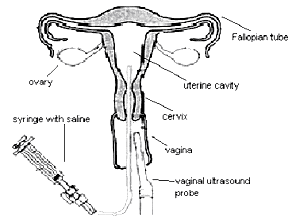
The speculum is removed and the vaginal ultrasound probe is inserted in the vagina.
A small amount of saline (salt water) is injected through the catheter. The saline allows accurate assessment of the uterine cavity. The saline dilates the uterine cavity slightly and outlines the lining of the uterus well, making it easier to assess the endometrium accurately and detect certain pathology like polyps.
The procedure takes approximately 5-10 minutes and is generally not more uncomfortable than a PAP smear.