
Down Syndrome screening
What is Down syndrome?
Down Syndrome is a condition that is associated with a range of developmental difficulties including delayed motor skills (such as sitting, crawling and walking in infancy) and delayed cognitive skills (such as speech and language acquisition and short-term memory abilities). It may cause physical problems such as hearing and vision defects, heart abnormalities, infection, leukaemia or thyroid disorders
The range of abilities and disabilities, characteristics, interests and achievements among people with Down syndrome vary widely, as with everyone.
With access to informed and effective health care, individuals with Down syndrome can now expect to live to 50-60 years of age.
Down syndrome is the most common cause of developmental disability. About 1 in 700 babies born in Victoria will have Down Syndrome.
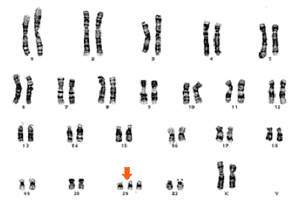
The most common cause of Down syndrome is when an infant is born with three, rather than two, copies of chromosome 21 (trisomy 21).
Chromosomes are the structures that contain the genetic information that we need to grow and develop normally. Each cell of our body contains 23 pairs, so 46 chromosomes, half of which are inherited from each parent.
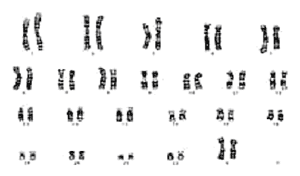
Children with Down syndrome, however, have cells that usually contain not 46, but 47 chromosomes, the extra one being a third chromosome 21. It is this extra genetic material in infants with Down syndrome that disrupts their physical and cognitive development.
Babies with Down syndrome are born at the same rate into families from all social, economic and racial backgrounds, and to parents of all ages. It is however known that the risk of giving birth to a child with Down syndrome increases with the age of the mother.
Risk for Trisomy 21
| Age | Risk at Birth | Risk at 12 Weeks |
| 20 | 1 in 1527 | 1 in 898 |
| 25 | 1 in 1352 | 1 in 795 |
| 30 | 1 in 895 | 1 in 526 |
| 32 | 1 in 659 | 1 in 388 |
| 34 | 1 in 446 | 1 in 262 |
| 36 | 1 in 280 | 1 in 165 |
| 38 | 1 in 167 | 1 in 98 |
| 40 | 1 in 97 | 1 in 57 |
| 42 | 1 in 55 | 1 in 32 |
| 44 | 1 in 30 | 1 in 18 |
But because younger women give birth more often, 80% of babies with Down syndrome are born to mothers younger than 35.
How can the risk of your baby having Down Syndrome be assessed?
There are several screening tests available.
1. Age
The simplest but least accurate screening test is asking the patient's age. Older women have a higher risk, young women a lower risk. Because younger women have more babies, most babies with Down Syndrome are born to younger women. Therefore most babies with Down syndrome would not be diagnosed antenatally if only age was used to discriminate between women with a high risk and women with a low risk for a Down Syndrome pregnancy.
2. Nuchal translucency Screening
The age related risk for Down Syndrome, or 'background risk' can be adjusted by looking at certain features in the fetus. Between 11 and 14 weeks the nuchal translucency can be measured during an ultrasound examination. The nuchal translucency measurement is a measurement of the fluid accumulated under the skin behind the baby's head and neck. Chromosome abnormalities such as Down Syndrome are often associated with an increased measurement. The age of the patient, the size of the fetus and the measurement of the nuchal translucency are subsequently entered in a computer program that will generate an adjusted risk for Down Syndrome. Women with a high risk will be offered further diagnostic testing.
The nuchal translucency assessment can detect 75% of Down Syndrome pregnancies.
Apart from assessing the risk of Down Syndrome, the 11-14 week ultrasound allows:
- accurate estimation of the due date
- early diagnosis of multiple pregnancy
- diagnosis of early miscarriage
- detection of quite a number of structural abnormalities
3. Combined first trimester screening
This test combines a nuchal translucency scan with a blood test between 10 and 12 weeks. The addition of the blood test improves the detection of Down syndrome from 75% to 85-90%. The blood test measures ßhCG and PAPP-A, two proteins that are produced by the placenta and cross into the mother's bloodstream. In Down Syndrome pregnancies the levels of these proteins tend to be different.
The blood test is most informative when done around 10 weeks. If the blood test is done at least a week before the ultrasound, it ensures that the laboratory will have analysed the blood by the time the ultrasound is done. At the time of the ultrasound, the measurements of the fetus and the nuchal translucency are faxed to the Maternal Serum Screening laboratory. In the laboratory the patient's age, the blood results and the ultrasound results are entered in a computer program that calculates a combined risk result for Down Syndrome. If the blood test was done in advance, the combined risk result is usually available within one hour after the scan. Women with a high risk will be offered further diagnostic testing.
4. Second trimester Maternal Serum Screening (MSS)
A blood test is performed between 14 and 20 weeks gestation. Four hormone levels are measured: unconjugated estradiol, ßhCG, AFP and Inhibin. These hormone levels are usually different in Down Syndrome pregnancies allowing an assessment of the risk for Down Syndrome. With the second trimester MSS approximately 70% of Down Syndrome pregnancies can be detected.
What is high risk and what is low risk?
A calculated risk higher than 1 in 300 is considered an increased risk for Down Syndrome. Approximately 1 in 20 women will have such an 'increased risk' result. This does not mean that the baby will definitely have Down Syndrome. On the contrary, most women with an 'increased risk' result will go on to have a normal baby. Patients with an increased risk will however be counselled about this result and will be offered a diagnostic test.
A calculated risk less than 1 in 300 suggests a low risk for Down Syndrome in this pregnancy. Approximately 19 out of 20 women will have a low risk result. And although a low risk is reassuring, it is not the same as no risk.
How can Down Syndrome be diagnosed?
There are two diagnostic tests that can be performed to confirm whether or not the baby has Down Syndrome or another chromosomal abnormality. These tests are chorionic villus sampling (CVS) or amniocentesis. Both tests have a small risk of miscarriage associated with them.
What can Camberwell Ultrasound for Women and Central Ultrasound for Women offer?
For many couples decisions regarding screening for Down Syndrome and prenatal testing are amongst the hardest and most stressful ones in the pregnancy. The range of different tests can be confusing, the anxiety associated with an unexpected increased risk result on one of the screening tests can be overwhelming, the decision whether or not to have a prenatal test at an advanced maternal age after low risk screening may be difficult. And decisions may even become more complicated when unintentionally 2 screening tests were performed giving conflicting results.
At Camberwell Ultrasound for Women and Central Ultrasound for Women , we deal with similar situations almost daily.
We offer couples counselling regarding Down syndrome screening, interpretation of test results, increased risks and prenatal testing. We perform nuchal translucency screening, combined first trimester screening, amniocentesis and chorionic villus sampling. Feel free to make an appointment simply for a consultation and discussion of the issues that you find confusing or worrying. When you come in for a screening or diagnostic test, we try to give you all the information you may need but don't hesitate to ask questions. It is only through good information that you can weigh of risks and benefits and make informed decisions that are right for you and your partner.